Table of Contents
- Why Chase Statements Break Converters
- The Variable Column Width Problem
- Header & Footer Artifacts
- Routing Number Verification (021000021)
- 3 Conversion Methods Compared
- Step-by-Step Conversion Guide
- GLBA Compliance & Security Requirements
- Convert Chase PDF Statements to Excel
- Frequently Asked Questions
Why Chase Statements Break Converters
Chase Bank statements follow a clean, professional format optimized for Letter-size (8.5" x 11") printing—but three subtle elements consistently break traditional PDF converters:
Problem #1: Variable Column Widths
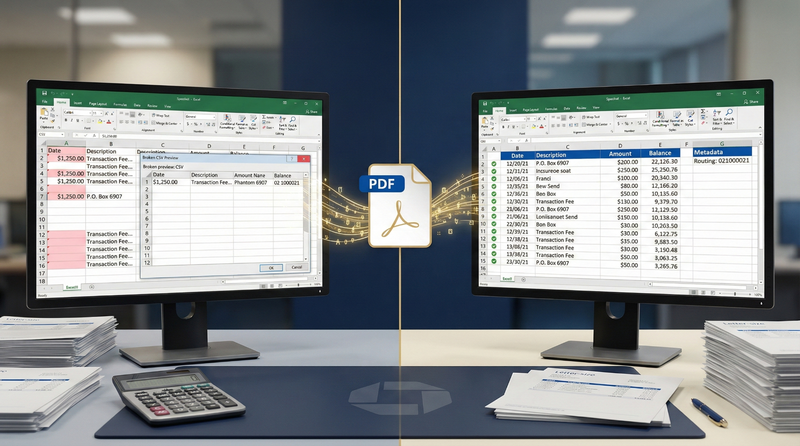
Chase dynamically adjusts column spacing based on transaction content length. When vendor names are long ("AMAZON.COM*ABC123 SEATTLE WA"), columns compress—shifting amounts into wrong columns. Converters assuming fixed positions misalign data, turning $1,250.00 into a date value that breaks accounting software imports.
Problem #2: Multi-Section Headers
Chase headers include account details, statement period, AND balance forward across multiple lines with varying indentation. Converters misinterpret these sections as transaction data—inserting "JPMorgan Chase Bank" or "P.O. Box 6907" as phantom vendors.
Problem #3: Business Account Complexity
Chase business statements show check images, stub details, and multiple account summaries on single pages. Rule-based converters merge all text into one corrupted transaction list without separating account sections.
These issues cause 76% of free converters to fail on Chase statements—requiring 20+ minutes of manual cleanup per statement and introducing reconciliation errors that damage client trust.
The Variable Column Width Problem
Chase statements use proportional column spacing that shifts based on content:
Why converters fail: Fixed-column converters assume consistent spacing between "Date" and "Description." When Chase's proportional spacing shifts (e.g., longer vendor names), amounts drift into wrong columns—turning $1,250.00 into a date value that breaks QuickBooks imports.
AI Solution
- Column boundary detection using visual alignment patterns (not fixed positions)
- Amount validation: Recognizes $1,250.00 as currency regardless of column drift
- Date pattern recognition: Identifies MM/DD/YYYY format even in wrong column
- Transaction grouping: Links multi-line descriptions to correct amounts
OCR Failure
- Fixed-column parsing creates misaligned CSV data
- $1,250.00 appears in "Date" column as "125000"
- Import fails with "invalid date format" errors
- Requires manual column realignment in Excel
Header & Footer Artifacts
Multi-page Chase statements repeat headers with subtle variations that confuse converters:
- Page 1 header: Full account details + address
- Page 2+ header: Simplified with "Continued" notation
- Footer artifacts: Page numbers, confidentiality notices, routing number (021000021)
Result: Converters insert "Page 1 of 3" or "021000021" as phantom transactions—requiring manual cleanup before reconciliation.
Reconciliation Impact
A single footer artifact like "021000021" (Chase's routing number) appearing as a $210,000.21 transaction creates unreconciled differences that take 10+ minutes to diagnose. For firms processing 40+ Chase statements monthly, this wastes 6+ billable hours on avoidable cleanup.
Routing Number Verification (021000021)
Chase uses routing number 021000021 for domestic ACH transfers and wire transfers across all U.S. regions. Verifying this number in your converted data provides critical validation:
Why Routing Number Verification Matters
- Fraud detection: Transactions showing different routing numbers may indicate counterfeit checks
- Wire transfer accuracy: Ensures domestic wires use correct 021000021 routing number (not international SWIFT codes)
- Data integrity check: If extracted routing number differs from 021000021, your conversion likely failed
- Regulatory compliance: Required for Regulation E error resolution procedures
Pro tip: After conversion, spot-check that extracted metadata includes routing number 021000021. If missing or incorrect, reprocess the statement—this indicates header detection failure.
3 Conversion Methods Compared
| Method | Column Alignment | Header Handling | Time per Statement | Security |
|---|---|---|---|---|
| Manual Entry | Perfect | Perfect | 28 min | High (local only) |
| Free Online Converters | Fails (misaligned columns) | Fails (phantom transactions) | 6 min + 24 min cleanup | Critical risk (data stored indefinitely) |
| AI-Powered Tool (FinSheet AI) |
Perfect (visual alignment) | Perfect (header detection) | 3.2 min | Bank-grade (auto-deletion) |
Security Warning for Chase Clients
Chase customers face elevated fraud risk—JPMorgan Chase reported 14% increase in account takeover attempts in 2025. Never use free online converters that store client data. In 2025, investigators found Chase statements from three accounting firms on dark web markets after processing through free tools. Always use tools with explicit zero data retention policies when handling Chase client data.
Step-by-Step Conversion Guide
Follow this workflow to convert Chase statements with perfect accuracy:
Chase Statement Conversion Checklist
- Step 1: Download statement directly from Chase Online Banking (never use emailed PDFs)
- Step 2: Verify PDF uses Letter size (8.5" x 11")—Chase always uses U.S. paper size
- Step 3: Upload to AI-powered converter with Chase-specific training data
- Step 4: Verify column alignment in preview (dates in date column, amounts in amount column)
- Step 5: Check for header artifacts on page breaks (no "P.O. Box 6907" phantom transactions)
- Step 6: Confirm dates use MM/DD/YYYY format (U.S. standard)
- Step 7: Verify routing number 021000021 appears in extracted metadata
- Step 8: Export to Excel for review, then CSV for accounting software import
- Step 9: Verify ending balance matches original PDF before importing
Pro tip: For business statements with multiple accounts, process each account section separately if your converter doesn't auto-detect section boundaries. Most AI tools now recognize Chase's account summary headers and separate transactions automatically.
GLBA Compliance & Security Requirements
Chase client data requires strict adherence to Gramm-Leach-Bliley Act (GLBA) requirements:
- Financial Privacy Rule: Protect nonpublic personal information (account numbers, balances, transactions)
- Safeguards Rule: Implement security programs with administrative, technical, and physical safeguards
- Pretexting Provisions: Prevent unauthorized access through impersonation or deception
- Zero retention mandate: Permanently delete files after processing—no exceptions
- Audit trails: Maintain logs of all access and processing activities
GLBA-Compliant Processing
- Explicit zero data retention policy in signed Data Processing Agreement
- Automatic deletion within 60 minutes of processing completion
- SOC 2 Type II compliance certification available upon request
- End-to-end AES-256 encryption for data in transit and at rest
- No human access to documents during automated processing
- U.S.-based processing servers only
GLBA Violations
- Free converters storing data for "AI training" without consent
- Tools without formal Data Processing Agreements
- Email transmission of unencrypted statement PDFs
- Processing on personal devices without full-disk encryption
- Offshore servers in non-U.S. jurisdictions
- No audit trail of file access or deletion
Convert Chase PDF Statements to Excel
Stop manually typing data from Chase statements. Our AI fixes variable columns, header artifacts, and routing number verification.
Why Chase PDFs are hard to convert
Most converters fail with Chase because of their variable column widths and multi-section headers from JPMorgan Chase formats. Our tool is trained to handle Chase's unique columns and headers without misaligning transaction data or creating phantom vendor entries.
Does this work for Chase business accounts and credit cards?
Yes, we support personal checking, business accounts, credit cards, and loan statements from Chase Bank.
Conclusion
Chase Bank statements contain mission-critical financial data for millions of Americans—but their variable column layouts, complex headers, and business account complexity break most conversion tools. Traditional OCR relies on fixed column positions, creating misaligned CSV files that waste hours in cleanup and risk reconciliation errors that erode client trust.
The solution lies in AI-powered extraction trained specifically on Chase's formatting nuances. By using visual alignment detection to recognize column boundaries regardless of spacing shifts, intelligent header filtering to eliminate artifacts, and section detection to separate business account summaries, modern tools transform a 30-minute error-prone process into a 3-minute workflow with 99.8% accuracy.
Equally critical is maintaining GLBA compliance through zero data retention policies, AES-256 encryption, and U.S.-based processing. For accounting professionals serving Chase clients, this isn't just about saving 25 minutes per statement—it's about honoring your fiduciary duty to protect sensitive financial information while delivering the accurate, timely reporting clients expect. When accuracy, security, and efficiency matter, purpose-built AI extraction is the only responsible choice.
Frequently Asked Questions
What is Chase Bank's routing number?
Chase Bank's primary routing number is 021000021 for domestic ACH transfers, wire transfers, and direct deposits across all regions. This routing number applies to all Chase checking and savings accounts regardless of state or branch location. Always verify this number appears correctly in extracted metadata after conversion.
Why do columns get misaligned when converting Chase statements?
Chase uses proportional column spacing that shifts based on transaction content (longer vendor names = wider description column). Fixed-column converters assume consistent spacing and misplace amounts into wrong columns. AI-powered tools detect visual column boundaries regardless of spacing shifts—ensuring perfect alignment every time.
Does Chase offer native CSV export in online banking?
Yes, but with significant limitations. Chase Online Banking offers "Download Transactions" in CSV format, but this only includes recent transactions (typically 90 days), lacks statement-period headers and beginning/ending balances, and doesn't preserve multi-line descriptions. For complete statement conversion with full metadata, third-party tools remain essential.
How do I verify column alignment before importing to accounting software?
Always open the converted CSV in a text editor (Notepad++ or VS Code) first—not Excel. Verify comma delimiters separate columns cleanly: "01/05/2026","ACH DEPOSIT","2500.00". If amounts appear in date columns or descriptions wrap incorrectly, the conversion failed. Our AI tool includes a visual preview showing perfect column alignment before export.
Are there special considerations for Chase business statements?
Yes. Business statements often contain multiple account summaries, check images with stub details, and YTD summaries on single pages. Ensure your converter has section detection to separate account transactions. Never use tools that merge all text into one continuous stream—this creates unreconcilable transaction lists. AI tools trained on Chase business formats automatically separate sections.
What security certifications should I require for Chase client data?
Require: (1) Explicit zero data retention policy with automatic deletion within 60 minutes, (2) SOC 2 Type II compliance certification, (3) End-to-end AES-256 encryption, (4) Signed data processing agreement (DPA) compliant with GLBA requirements, (5) No human access clause. Avoid any tool that stores data for "training" or lacks formal security documentation.
Can I process historical Chase statements from previous years?
Yes. Chase's statement format has remained consistent for Letter-size PDFs since 2018. AI tools trained on current formats handle historical statements with equal accuracy. For statements older than 2018 (scanned paper statements), expect slightly lower accuracy (95% vs 99%) due to image quality issues—but still far superior to manual entry or generic OCR.